Sunday, September 17, 2023

DNA-based computing is a promising tool for high-power data systems.

 DNA-based computing is a promising tool for high-power data systems. 


DNA and biochemistry with molecular biology are emerging and promising tools for high-power computing. The DNA-based computers can use the biochemical core along with DNA. And then, that system can communicate with regular microelectronics. The system can run over 100 billion programs, and that makes the system an interesting multi-tasker.

The DNA molecules can act as the programs for next-generation AI-based microchip-kernel applications. Chemical DNA computing uses nanotechnical systems to make the DNA that acts as the perforated tape in that system. In those models, the DNA transfers information between processors. In that model, DNA replaces electric wires in components as data transporter. But it requires fast-operating nanotechnology. 

The most futuristic visions of DNA-based computers are computers that use fast-operating nanotechnology. In that model, the system creates the synthetic DNA molecules by using nanotechnology. And those DNA molecules act like perforated tape of the old-fashioned computers. However, the system can use the DNA as a tool that can run complex AI-based software. And maybe the AI-based kernel architecture uses the DNA molecules as programs. 


There are three types of electric DNA computers. Or, the number of DNA-based computers depends on how we determine the use of the DNA in those systems. 


1) The computers that use DNA molecules as the microprocessors. Those DNA bites can act as part of regular-looking microchips. 


1a) The DNA can act as an information handler itself. 

1b) The DNA can act as a program for the ROM circuits. 


2) The computers that use DNA as the components like springs that control switches. 


3) Living cells that are used to process information. 


3a) Dummy systems, or systems that use dummy cells. Those systems can be bacteria which fibers can act as connectors. Those bacteria can be microchip controlled. 


3b) The systems that use intelligent cells like living neurons as data handlers.


In DNA-based computing, DNA is the tool that replaced regular microchips. If each base pair is one state of the DNA-based microprocessor. Data travels from the first vertical strand through horizontal base pairs to another main strand. That thing gives the DNA the ability to run billions of programs at the same time. The system can work like this. The microchip or some optical system transports data from regular microchips to DNA. 

The system can use miniature lasers that shoot photons to silicon bites. Those silicone bites are at the point of every base pair. Their mission is to transfer photons into electric impulses. Then data travels through those base pairs into the DNA's other side. DNA-based computing is a new and promising tool. The DNA computer's multi-tasking ability can used in quantum computing. That means every base pair acts as one qubit's state. This thing makes those systems even more powerful than nobody expected. 


https://www.britannica.com/technology/DNA-computing

https://futurism.com/worlds-first-reprogrammable-dna-computer

https://www.msn.com/en-us/news/technology/dna-based-computer-can-run-100-billion-different-programs/ar-AA1gF86Y

https://www.wired.com/story/finally-a-dna-computer-that-can-actually-be-reprogrammed/

https://en.wikipedia.org/wiki/DNA_computing


Micro LEDs and neutrinos are new tools for next-generation optical computing.

   Micro LEDs and neutrinos are new tools for next-generation optical computing. 


Optical computing is one of the most promising tools for creating new and powerful computers. Similar theories that researchers made for regular computers can be used in optical computers. The problem is how to transform photons into electric information. In some models, information travels between switches and photon transistors and gates in photon form. 

At the point where information travels to a switch or router a photovoltaic cell turns it into the electric form. And the other side the miniature LED turns it back into the photonic form. Or the router can replaced by using miniature mirrors. That increases the photonic volume in the data processing. 

"Researchers have highlighted the potential of on-chip nanophotonic systems as a solution to the challenges presented by traditional electrical networks. These systems utilize light for data transmission, offering increased bandwidth and speed". (ScitechDaily.com/Quantum Well Nanowire Array Micro-LEDs: The Future of On-chip Optical Communication)


The optical computer is light and in the binary version when light is on, the value in the system is one. And when light is off the value is zero. The problem is how to blink light fast enough. 


The answer for that could be nano-LEDs or a system that looks like a camera shutter. When the shutter lets the light go to the photovoltaic cell the value is one. And when the shutter is shut, the value is zero. That allows to make the optical or half-optical computer by using regular lights.

If the system uses two routes for transmitting data is possible to make even faster computers. The system requires AI-based control, but in a binary system values one and zero have different routes. So route one gives value one. And route two gives a value of zero. Or opposite. The speed of shutters determines the speed of the computer. 

Making the optical computer by using two lights that send their light to photovoltaic cells is possible. Cell number one gives a value of zero. Cell number one gives value one. There should be fast-moving shutters like in cameras between those photovoltaic cells and the light source. 

The nano LEDs can be the tools that can also make the optical computers fast. The system can control those nano LEDs with very high accuracy. Computers can use Those LEDs in extremely small nano-lasers. Those nano-lasers could give very high-accurate light impulses to systems that turn the binary data into quantum mode. 


"New research has discovered new interactions between neutrinos and photons, potentially shedding light on mysteries in particle physics and solar phenomena". (ScitechDaily.com/Neutrino-Photon Interactions: Unlocking the Mysteries of Particle Physics)


The neutrino is the almost perfect qubit. But the problem is: how to get neutrinos? 


The photon-neutrino interaction is the next-generation thing, that could use in quantum computers. Neutrino is a very weakly interacting particle, that interacts with photons. In some visions, the photons can be used to load information into neutrinos. 

The system uses single photons where information is loaded, and those photons will turn those neutrinos into qubits that can transport information over long distances. And then the neutrino detector will remove that data from neutrinos. The idea about neutrino qubits is based on the model that neutrino can have superposition like all other elementary particles.  

The problem with neutrinos is that they are hard to get. In some visions, the photons are used to stop the neutrino and then the information will load into it. Then some kind of EM radiation transfers that neutrino into the wanted direction. Then photon impacts or neutrino detectors can be used to download information from neutrino.


https://www.sciencealert.com/neutrinos-ghost-particles-can-interact-with-light-after-all


https://scitechdaily.com/neutrino-photon-interactions-unlocking-the-mysteries-of-particle-physics/


https://scitechdaily.com/quantum-well-nanowire-array-micro-leds-the-future-of-on-chip-optical-communication/


Saturday, September 16, 2023

The next step in generative AI is interactive generative AI.

The next step in generative AI is interactive generative AI.


The interactive AI means that the person just talks to AI and then AI follows the orders. The ability to use the natural language makes it easier to communicate with robots. The human operators can give instructions to robots on what they should do next. 

The interactive AI-based translator makes it possible. People can use their languages in communication whenever they want. The translation program can installed on cell phones. And then people can use it like any other social media program. The communication could happen through central computers where the server program translates words to the target language. 

Or the system can use the morphing network or cloud-based architecture where a cloud of cell phones shares their calculation capacity. Interactive AI can also be a powerful tool for programming and any other things like the R&D process of physical tools. 

The interactive AI can give instructions to programmers. Or it can generate the code from examples. Then the AI asks for the databases' names that want to connect with the program. If AI has access to hard disk, it can search those databases itself, and make the paths. 

There is the possibility that the AI has a multi-tasking user interface. If the names are not  said clearly. The AI can ask to write those filenames. Or it can suggest files that look a little bit about the name that AI heard. The AI can give lists about the found names and then the user can select the right one. 

The next big step in the development of AI is interactive, generative AI. Traditional generative AI just follows the order like "draw me a flower". And then the generative AI just creates that image. Interactive AI discusses with the user, it asks what colors and surfaces the user wants to use in the flower. 


The person can ask to make the yellow flower with crystal leaves and metallic surface and interactive AI just starts to make the flower. During that process, after every stage, it asks is customer happy. Is there something that wanted to change, or is there some hue of color that the user wants to use? 

If the user wants the AI to make a painting, the AI might ask if is there some painting, that the user wants to use as the base. Then the AI asks what parts are the best in the painting, and then it might ask what details the user wants to use in the AI-generated version. 

In the case of the R&D process, the interactive AI is the tool that can ask if is there some airfield where the aircraft must fit. Then it can ask some special variables what are the wanted payload and other abilities that the system must have. If AI creates drones it requires the computer code, that it uses. 

The complicated AI requires powerful computers, and those computers require cooling systems and other kinds of things. Also, the sensors and other things like the drone's purpose determine it's size. The things that the AI also requires are manufacturing tools and available materials. Interactive AI is a tool that discusses with people during the generative process. 

If the interactive AI  drives a car it acts like a second driver. The system might observe a human driver, and if that person is tired or nervous, it can ask what's problem, is and tell that the person needs a break. The interactive AI can take information from the traffic control and adjust the car's speed to a level that it must not stop. The AI can also make a report to authorities if the person seems drunk or somehow angry and request traffic police to stop the driving. 

If a driver makes the mistake that takes the car into the traction. AI can fix that error. When AI takes control the clutch separates the wheel from the power steering so that the driver cannot turn the car. That thing is an important detail in robot cabs. If a drunk person can take a car in control, that thing causes a terrible situation. 

When every single wheel is operated in separate electric engines the AI can adjust their rotation direction and rotation speed. These kinds of systems can installed in hybrid and electric cars. This type of vehicle can use diesel- (or combustion)-electric driving systems. And those systems make them very fast. 


https://www.analyticsinsight.net/interactive-ai-a-step-closer-to-conversational-artificial-intelligence/

The neural spiral in our brains can mean very much to the human species.

 The neural spiral in our brains can mean very much to the human species.


And researchers can use the human brain as the model for AI-based solutions that are better than ever before. 


The neural spiral in the human brain is an impressive thing. It transmits information around our brain. And that thing is suspected behind the consequence. The thing in the neural spiral is that it gives brains the ability to analyze situations better. 

And that neural spiral gives us the thing called patience. That neural spiral makes our neural system better than insects. In insects neural system signals travel in one direction and that thing gives them an effective ability to handle information. 

But that thing means that if an insect decides to attack it will not think about the situation anymore, and that thing causes death if it attacks against the superior predator. If a human sees a cave bear human will go to a weapon before the hunter even thinks of attacking against bear. The neural spiral gives the hunter deliberation, and that ability is the thing that can save the hunter's life. 


Researchers used the human and other specie's brains as a model for high-power supercomputers. The human brain works like a computer. And that means it can give a model for next-generation systems. 


The thing is that researchers can model the neural spiral from the human brain into computers and morph networks. The AI-based morphing network means that the system can, as an example, forget things. The AI can have values that if the system doesn't use some database in a certain time the system removes those files. 

If we think about the mark of the recycling center, we can think that arrows are the sequences or pulses when data travels between computers. And at the end of every pulse is the computer. The system drives data in the direction where arrows show. And every time the data travels through the computer, that system analyzes the data that is handled by a computer. That is behind that ring. 


Image: Recycle mark can used as a model for spiral computing structure. Every arrow symbolizes the pulse where information travels between computers. And then after each pulse, the information travels through the computer that processes it. The number of processing sequences depends on how many times information travels in that circle. 

So the system can send the data to travel around this spiral or ring, and in every pulse, the data system can breed the information. That kind of system can be the ultimate tool for AI to analyze data. The type of those computers is not important. And they could be regular binary computers, DNA-based computers that can drive billions of programs at one time or they can be quantum computers. 


The AI-based kernel can make computers more powerful than ever before. And carbon nanotubes can make lightweight quantum computers possible. Every layer in the carbon nanotube is one state of qubit. So the four-layer carbon nanotube can act as a qubit where is one layer for zero, and three layers are for states 1,2, and 3. In the image is a layer nanotube, that could have qubit states 0,1 and 2. 

Maybe those lightweight systems are not as powerful as some superquantum computers. But they are more powerful than modern binary PCs.  And nobody expects that laptops can make the same things as supercomputers. 

The AI-based kernel can improve the system's power in every computer type. The binary computer can use different wires for transmitting one and zero. In that model, electricity that travels in wire one gives value one. And the electricity that travels in the wire two gives a value of zero. That thing makes the binary computer faster than ever before. And AI-based kernels can make this kind of system possible. 

By using fullerene nanotubes is possible to transmit information. In the form of qubits. In that model, each layer in a multi-layer nanotube is a certain state of the qubit. The quantum system can transfer data to those multi-layer carbon nanotubes. And that makes some kind of lightweight quantum computer possible. 

If there are four layers in the nanotube, that thing means that there is one zero layer and three states in qubits. This kind of system might not seem very impressive. But we can say that this kind of system's calculation power is enough for many simulations. 

The fact is that. The Internet allows to use of high-power quantum computers over the net by using laptops or even mobile telephones. That means the high-power quantum computers can be far away from their users. 

So lightweight quantum computers are not as powerful as super-powerful quantum computers that are in data centers. We can say that we don't even think that some laptops or home PCs have the same calculation power as some supercomputers have. However, the internet allows the users of the laptops can use the abilities of supercomputers. 


https://neurosciencenews.com/perception-brain-computer-23919/

https://www.sciencealert.com/liquid-computer-made-from-dna-comprises-billions-of-circuits

https://scitechdaily.com/biological-masterpiece-evolution-wired-human-brains-to-act-like-supercomputers/

Radio transmission is the weak point of modern military drones.

 Radio transmission is the weak point of modern military drones. 


The new British military jet-propelled "Hydra 400"quadcopter is an interesting design. 


The new jet-propelled drone is an interesting design. The jet-propelled quadcopter can fly fast. And it can raise more cargo from the ground than electric engine drones. There is a possibility that these kinds of quadcopters can used as "quad autogyros". 

In those designs, the quadcopters use their quad rotors for lift-off and landing. During a long-distance flight. The drone can use free-rotation propellers and a jet engine. And that thing makes those drones fast. 

Those drones can used as kamikaze drones. Or they can launch missiles like Javelins if they are connected to them. The kamikaze quadcopters are interesting tools because they can observe the area. And if there are no targets those drones can return to base. 

But if there are some kind of targets the drone can make it's surveillance mission and then attack targets when their flight time ends. The drones can use an image-recognition homing system that allows them to take out targets with very high accuracy. 


Above Hydra-drone. 

The military is interested in independently operating drones is that those drones don't require full-time communication between the drone and HQ. The Ukraine war shows how dangerous full-time radio communication is. If the electronic intelligence finds the transmitter, the enemy can turn every cannon against those command centers. So the kamikaze-recon drone can transmit data to the command center and then dive against the target. And that helps to hide the place of the command system. 

The full-time operating radio transmissions are dangerous for drone swarms. The drone swarm where hundreds of members is a suitable target for large anti-aircraft missiles or AA grenades. Similar ELINT systems that are used for track radio transmitters also aim AA cannons at those drone swarms. High-power radio waves can jam the data communication in that drone swarm. 

Those missiles could equipped with a similar homing system as HARM (High-speed Anti Radiation missiles). The HARM-type missiles are also deadly against any radio transmitters. 

Normally HARM is shot from the aircraft. Portable shoulder-launched Stinger missiles also have a so-called "Anti-radiation variant" called Stinger ARM (Anti-Radiation Missiles) that can detect and destroy enemy radiation sources. That makes radio telephones missile magnets if the enemy can track their positions by using radio detectors. 

But there is the possibility that those missiles can be mounted on rocket launchers or warships. Warships can also use those missiles against enemy surface combat unit's radars. And that means the artillery rockets and grenades can have a warhead that can detect radio transmitters. 


https://interestingengineering.com/military/british-army-jet-propelled-drones


https://en.wikipedia.org/wiki/Autogyro


Chinese researchers manipulated miniature robots with laser rays.

 Chinese researchers manipulated miniature robots with laser rays. 


Manipulating miniature robots with lasers can lead the road to next-generation nanotechnology. The system can manipulate nanostructures by benefiting the different material's ability to absorb different wavelengths. In another version, the feet and arms of the nanorobot are made by using different materials. And in that case, different materials can move by using lasers with different wavelengths. 

The system can benefit the protein and temperature interaction that affects the length of protein fibers. 

When a laser ray hits material it raises its temperature and makes it possible to manipulate the bonds. So if the left leg of the robot absorbs blue laser light stronger than the right leg, that causes a situation in which the laser raises the left leg's temperature. That thing causes a situation. Where the left leg moves faster than the right leg. 


"Researchers develop tiny "dancing" robots." (https://interestingengineering.com/innovation/chinese-researchers-create-dancing-microrobots-using-lasers)


The ability to manipulate nanomaterials makes it possible to create complicated structures that do not require internal power sources. And that makes it possible to create complicated molecular structures that the system can manipulate by stressing them with multi-band laser rays. That kind of ability can improve nanomachine abilities. 

The complicated actions require complicated movements. And that thing gives molecular-size nanorobots new roles. In medical work the nanorobot that looks like a hairy ball can slip in the cell. Then the laser will send energy impulses to those balls that will push their hair out. That causes a situation, where the ball fills the cell. 

In some other versions, the limbs are a different number of photovoltaic materials. That means laser affects those limbs at different times. But in complicated models. The laser ray can simply transfer electricity to the miniature robots. Lasers are multipurpose tools that can transport information and electricity, and lasers can used as weapons. That makes those systems interesting from the point of view of DARPA. 

Those laser systems can do all those missions. They can used as tools for delivering commands and electricity for small-size drones. That thing is one of the ways the systems can use their multi-use capacities. 


https://interestingengineering.com/innovation/chinese-researchers-create-dancing-microrobots-using-lasers


https://scitechdaily.com/quantum-breakthrough-scientists-develop-new-way-to-manipulate-exotic-materials/


Friday, September 15, 2023

Beyond Moore's law: how to make more powerful computers.

 Beyond Moore's law: how to make more powerful computers. 


The main problem is how to keep the temperature in the computer system low. 


Moore's law means that the number of transistors in microprocessors grows exponentially in time units. Or otherwise saying the number of transistors will double every year. Moore's law is not reality anymore. The reason for that is when the size of microprocessors and transistors is getting smaller, quantum phenomena like electromagnetic whirls cause problems. The resistance raises temperature which causes oscillation in wires. And that oscillation is the thing that disturbs high-power data transmission. 

The reason why the researchers wanted to keep the size of microchips small is that long wires cause temperature problems and the electromagnetic turbulence and outside electromagnetic effects are causing more problems for microchips than short wires. And that's why a small microchip is less vulnerable to outcoming radio interference than large-scale microchips. 


Above: A supercomputer center


Above fullerene nanotube. But that image could portray EMP-protected wire that is in a Faraday cage. 

How to remove the electromagnetic oscillation and outside EMP effect from computers? 


The EMP protection allows to use of larger-size microchips and high-power coolers can stabilize the wires. Reseachers must cover every single by using a Faraday cage, and the system must keep their temperatures low. 

But one version to remove the outcoming effects is to use the EMP-protection in the wires. The image that portrays a fullerene nanotube can portray EMP-protected wires. Those wires would be closed in a Faraday cage that removes the electromagnetic effect from those wires. 

1) The microchip's size can turn bigger. Making bigger microchips with high-power cooling systems makes it possible to create microchips that have more transistors and diodes than existing microchips. 

The advanced cooling systems can keep the temperature low. However, those microchips can be suitable only for supercomputer centers. Those large-size microchips require EMP protection and advanced cooling systems. And that's why they are not suitable for home computers. 

2) The system can use photonic computing. In photonic computers, the laser rays are replaced by regular copper wires. The laser transmits data to the small-size light- or photovoltaic cell. And that silicon crystal turns flashes of light into zero and one. Photonic computers can keep their temperatures lower than regular computers. 

3) The third method is to control the system more effectively. The AI-based operating systems can keep the temperature in the microchips optimal. And that means the AI-based systems can share missions between multi-core processors more effectively. In those systems when the temperature rises in one processor, the AI can route the missions into other processors. 

That allows for decreased temperature in those processors. And, of course, the system can share its missions between multiple components. Those components can be independently operating computers even if they are in the same box.  The AI-based network can share its missions also between physical systems. 


https://dailycaller.com/2018/04/09/rick-perry-supercomputers/


https://scitechdaily.com/beyond-moores-law-mits-innovative-lightning-system-combines-light-and-electrons-for-faster-computing/


https://en.wikipedia.org/wiki/Moore%27s_law

The 2D materials give the possibility to create new lightweight and stronger-than-diamond materials.

 The 2D materials give the possibility to create new lightweight and stronger-than-diamond materials.


The 2D materials are the next-generation products. That allows researchers to create strong and lightweight structures. The problem with 2D materials like graphene is that they lose their abilities if they cannot keep their 2D structures.

Another problem is how to produce a large mass of graphene. Graphene itself is a material that makes it possible to create materials stronger than diamond. 

Researchers can use graphene as boxes, which walls are created by using graphene. The fullerene nanotubes can form the frame inside the graphene box. Or the graphene boxes can connect by using those nanotubes.  When graphene is connected with another carbon's allotropic form called ANDR (Aggregated diamond nanorod) that thing can create a structure that resists vertical strikes better than diamonds. 


The ANDR nanorods can be put as frames in those graphene boxes to give extra strength to those materials. Manufacturing systems can install those graphene boxes on a layer using DNA bites. They act as nano springs whose mission is to remove impact energy. 

The problem is how to produce enough of those nanorods and graphene. There is also the possibility to cover the graphene layer by using nanodiamonds. Those nanodiamonds form pyramid-shaped structures over graphene. Those nanodiamonds are the tools that can used in the next-generation stealth materials. 

Those graphene boxes are giving a new type of extremely hard layer for any shell. That kind of layer is useful in the spacecraft. But it could be game-changing armor in many military tools. 

The new materials require new production methods.  Production and handling of those new materials require AI-controlled chemical and physical environments. 

Structures that can be stronger than diamonds  Are useful for tools that must bite extremely strong materials. 

Graphene production is a very easy process. The system must only cover some layers by using graphite. Then the laser just planes extra carbon layers away from that material. The lasers or other electromagnetic systems can press regular cylinder-shaped nanotubes together. That kind of technology can turn regular nanotubes into ANDR nanorods. The thing is that nanomaterials are coming. 


https://scitechdaily.com/quantum-breakthrough-scientists-develop-new-way-to-manipulate-exotic-materials/


https://en.wikipedia.org/wiki/Aggregated_diamond_nanorod


https://en.wikipedia.org/wiki/Carbon_nanotube


The new kamikaze quadcopter could be a game-changer. But it can also cause risk for security.

  The new kamikaze quadcopter could be a game-changer. But it can also cause risk for security. 


The new large-size anti-tank quadcopter is a tool whose abilities have not been realized yet. Aircraft or satellites can drop those kamikaze quadcopters into some operational area. And if the target for those systems is the silo-based ICBM systems. The quadcopter can wait for the silo's hatch to be open. Then those quadcopters will fly over the ICBM and detonate themselves just when the missile is firing. Anti-tank quadcopters can make holes in the submarine's hulls. 

Also, agents can carry those kamikaze quadcopters near airfields or other military bases. Then those drones will fly into the ammunition dumps or they can cause damage to radar systems or electric supply, destroy aircraft, or detonate ammunition dumps. 


"Rotem Alpha anti-tank drone at DSEI 2023 in London Image: DAVID HAMBLING" (Forbes.com/Super-Sized, Super-Smart Kamikaze Quadcopter ‘Bringing Anti-Tank Dominance)

Artificial intelligence creates other programs. And that makes it a very powerful tool. By using freeware tools is possible to make customized software for less than 7 Euros an hour. The ChatBot type AI can operate as a development tool for creating software for robots. That allows the system to create customized software for civil and military drones. 

When we think about killer drones the system must only know the point where it should land, and then the system must not have slow-down mode. The ChatBot-type software generators can modify any drone in the world into a killer drone. When we think of killer drones. We are facing a very dangerous situation. In that situation, only one drone that is sold to the wrong hands can cause catastrophic. 

It's possible to download that control software from that drone. And then operators can load that software to any quadcopter. That means that in the wrong hands. Those systems are high-risk for national security. 

The new quadcopter-looking kamikaze drone is a good example of how cheap AI is. R&D work with that application is expensive things. But when the software is ready, it can scale all over the entirety. 

When software is developed system can download it into any tool, connected with it. The morphing neural network topology makes it possible to program one drone, and then that drone will transmit its program over the entire network. The AI-based applications can interconnect every system into one entirety. 


https://www.forbes.com/sites/davidhambling/2023/09/14/super-sized-super-smart-kamikaze-quadcopter-bringing-anti-tank-dominance/

Thursday, September 14, 2023

Photon-neutrino interactions open new views to those mysterious particles.

  Photon-neutrino interactions open new views to those mysterious particles. 


In some visions, the neutrino is very close to hypothetical WIMP (Weakly interacting massive particle) which are dark matter particles. There could be two ways how WIMP can be massive. One is that a single WIMP can have a higher energy level than visible material. And the second is that there are lots of WIMPs that are massive in entirety. 

So the WIMP makes interaction between visible material as a group. In some models, there are two types of WIMPs. The high-energy WIMPs form the hot dark matter. And low-energy WIMPs could be particles of the cold dark matter. And in visible material. The energy level is between those hot and cold WIMPs or hot and cold dark matter. 

Normally, think that the universe has three main parts. Those parts are dark energy, dark matter, and visible material. In some models, there is hot and cold dark matter. And visible material is between those dark matter types. The thing, that determines material visibility is the direction of energy flow. If energy travels from higher energy material into lower energy material. 

And there is no echo from that material. The interaction is one-way. That means there is no energy flow back to higher energy particles, and that makes lower energy particles invisible. In that model, energy flows from visible matter into cold dark matter. And that makes cold dark matter invisible to us. 

There is the possibility that there is also the fourth type of material, which we can call grey material. That grey material is something between dark and visible material. 


"New research has discovered new interactions between neutrinos and photons, potentially shedding light on mysteries in particle physics and solar phenomena." (ScitechDaily.com/Neutrino-Photon Interactions: Unlocking the Mysteries of Particle Physics)

We can think that "dark matter" is so-called hot dark matter. Which energy level is higher than the visible material's energy level? 

When hot dark matter loses its energy it turns into visible material, and when visible material loses its energy. It turns into cold dark matter. In that model, dark energy is the last view of material before it falls into 2D form.

In that model, the neutrino could represent very old material that lost its energy. Because neutrino's energy level is very low it's hard to detect. And it loses its energy into the cold dark matter. This model is conducted from the model of the universe's ultimate fate. The fate of material is turned into wave movement. And maybe neutrino is the particle that is transforming from the visible material into dark matter. 

Neutrinos are one of the most interesting. And at the same time very mysterious particles. Those particles have mass, but they do not have strong interactions. That makes neutrinos able to travel through planets. And kilometers-thick lead doesn't stop those particles. There is a possibility that neutrinos can travel through neutron stars, and if that thing is true, they can help us to understand the dense objects in the universe.

But in that case, researchers must confirm that those neutrinos traveled through the neutron stars. The photon-neutrino impacts open new views to those mysterious particles. If we think about the shape of the neutrino, they could be very interesting tools in quantum technology. Neutrinos could transport information over long distances. 

So quantum computers could use neutrinos in long-distance quantum communication. The problem is that those neutrinos are hard to capture and manipulate. And that thing makes it hard to benefit them. But if researchers could someday capture neutrinos in photon traps, they can have the tool that can used in high-class quantum systems that can observe interactions inside atoms. 


https://scitechdaily.com/neutrino-photon-interactions-unlocking-the-mysteries-of-particle-physics/


https://miraclesofthequantumworld.blogspot.com/p/the-cosmic-structure-growth-is.html

The cosmic structure growth is suppressed, and nobody knows why.

   The cosmic structure growth is suppressed, and nobody knows why.


The question is about the effects of dark matter and dark energy. There is a theory that there are two dark matter types. Hot dark matter is a material. Whose energy level is higher than visible material. Cold dark matter is material whose energy level is lower than visible material. 


Which way does energy travel? In this image, we can think that hot dark matter is the thing that is marked "dark matter". When that hypothetical material's energy level decreases. It turns into visible materials or atoms. Finally, it turns into cold dark matter and when those particles collapse into a 2D form they will make a short-term pothole that fills, and when quantum fields impact that pothole. They send energy impulses, that we see as dark energy. 


So energy travels from hot dark matter through visible matter into cold dark matter. The cold dark matter would be material that has a 2-dimensional structure. And that makes the cold dark matter act like an energy vampire. Energy travels from visible material into cold dark matter.

Maybe cold dark matter is the basic energy level in space. Where our universe exists. That cold dark matter would be invisible because energy travels into that material. The reason, why there are no signs of that cold dark matter is that there are lots more cold dark matter than visible matter. 

But when energy impacts dark matter particles they send that energy into other dark matter particles. And that energy moves the dark matter could. That could be the dark energy. 


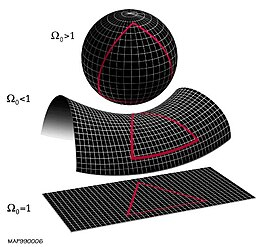
"The local geometry of the universe is determined by whether the density parameter Ω is greater than, less than, or equal to 1. From top to bottom: a spherical universe with Ω > 1, a hyperbolic universe with Ω < 1, and a flat universe with Ω = 1. These depictions of two-dimensional surfaces are merely easily visualizable analogs to the 3-dimensional structure of (local) space". (Wikipedia, Shape of the universe)

Geometric shape of the universe. 


The reason why we cannot see hot dark matter either is when that material sends the radiation that we can detect it has turned into Higgs boson and then through the chains into stable electrons. And after that when that electron (or any other elementary particle) loses its mass, it turns into cold dark matter. 


Cosmic microwave background


The place of the cold and hot dark matter can be successively after visible material. And in that model, visible material is at the top energy level. In that model energy also travels into the dark matter and because there are lots of more dark matter particles than visible matter, that means the energy that travels into the dark matter. And then, it starts to travel between those dark matter particles. 


Cosmic gamma-ray background 


When we are looking at cosmic micro, gamma, and X-ray backgrounds, we can conclude that gravitational background forms similar structures as some of the cosmic backgrounds. That means gravitational waves or gravitational radiation is not homogenous. That causes the induction conclusion that the universe cannot be purely spherical, hyperbolic, or even flat. 


Cosmic X-ray background. 


The universe's shape would be like a rag, where one corner turned up. In that model, the universe's shape is a combination of those geometrical shapes.  The question about the universe's shape is interesting because it should be a combination of all of those geometrical possibilities. 

Most researchers believe that the universe is flat. But there is a model. where the material that forms our universe is like a ball above that flat universe. If that model is real, energy travels from that ball into that universe or energy level below it. 

In that model, the universe or the 3D material is like a ball, that hovers above the material the energy level is under detectable level. And that material is mainly the cold dark matter. If the cold dark matter's energy level is lower than the visible material's minimum energy level. That means energy travels from visible 3D material to that 2D material, and our universe is like a ball, that hovers in space. 


https://scitechdaily.com/universe-defies-einsteins-predictions-cosmic-structure-growth-mysteriously-suppressed/


https://en.wikipedia.org/wiki/Dark_matter


https://en.wikipedia.org/wiki/Shape_of_the_universe


Cosmic background images Space com, ESA and NASA

The MMX mission aims to collect a 15-gram sample from Phobos. It is on the way to Mars.

“This artist's concept of JAXA's Martian Moons eXploration (MMX) mission shows the deployed spacecraft, Mars, and Mars's largest...