Showing posts with label engines. Show all posts

Sunday, January 5, 2025

The electromagnetic thrusters will revolutionize space missions.


"A solar-powered electromagnetic propulsion (EP) spacecraft design. Credit: NASA" (ScitechDaily, How Electric Thrusters Are Revolutionizing Space Exploration)

Ion and electron engines revolutionize space technology. 

All electromagnetic thrusters are not ion systems. Some engine systems use lasers and microwave systems to boil frozen liquids and water to make pressure for rocket engines. 

Those systems are not as new as people believe. In 2007 the Dawn space probe used ion engines in a successful mission to research asteroids Ceres, Vesta, Juno, and Pallas. That ion thruster allowed it to operate and make maneuvers in the asteroid belt. 


Those systems make long-term propulsion possible. And they can make things like Mars missions more effective. 

Ion thrusters can use solar power. As well as they are suitable for nuclear reactors. And that makes them good tools for things like asteroid belt missions. Solar-power ion thrusters are also suitable for orbital missions. The satellite that can use ion thrusters can operate very flexibly. And it can make them good for scientific and military missions. 

The problem with ion thrusters is that those systems have very weak thrust. The answer could be the Medusa-drive type solution. There those ions will be blown to the solar sail-type structure. 

That ion sail will give new abilities for those systems. That increases their thrust. 


"Pictured is a 6 kW Hall thruster in operation at the NASA Jet Propulsion Laboratory. Credit: NASA" (ScitechDaily, How Electric Thrusters Are Revolutionizing Space Exploration)


Or, the system can use the high-energy plasma that injects it into the engine system. That looks like the hood or the bell. The system shoots a laser beam through that plasma. 

That makes it a whirl. The plasma whirl will press against the front side of the chamber. The ion thrusters are interesting military. Because they can be used as weapons. 

The problem is ions repel each other. That spreads those ion beams. 

How to keep the beam in its form.  In some versions. The target must be loaded with opposite-polar electricity. 


Or something puts magnets on a satellite shell or behind a satellite. 

That pulls plasma from the Van Allen belt to the target. 

That pulls ions or anions to it. Another way to keep the ion beam in its shape is an ion cannon. That shoots an electron beam along with an ion beam. And those opposite polar particles should keep that beam in its form. 

The ion thruster can create the ion layer between satellites and the ground station. That ion system denies communication between ground stations and satellites. 

And it's an effective way to jam the GPS. The ion layer between aircraft and radars makes it impossible to see the ground from the air. But it also can deny ground radars to see the flying aircraft. 


https://scitechdaily.com/plasma-powered-rocket-designed-for-deep-space-exploration/


https://aiandthefuture.wordpress.com/2025/01/05/the-electromagnetic-thrusters-will-revolutionize-space-missions/



Wednesday, September 27, 2023

The new types of engines use cold atoms to make electricity.

 The new types of engines use cold atoms to make electricity. 


The new piston engine creates energy from ultra-cold atoms. The idea is that those ultra-cold atoms will be injected into the chamber. There the explosion of the ultra-cold atoms moves the piston. 

The new type of engine creates energy from ultra-cold atoms. The engine benefits energy flow between objects in different energy levels. The energy always flows from a higher energy level to a lower energy level. 

The first Stirling engines used hot air. The design of that engine is from the 19th century. Then the steam and combustion engines replaced that system. The Stirling engines can use solar power for making needed thermodifference. And that thing makes them promising tools for green engineering. 

But basically, engineers can make the same eff by using a room temperature system. And on the other side will be a box, filled with a block of extremely ice. In that engine the air flow is important. And the thing that makes this airflow is the difference in temperatures on both sides of the engine. 

The most interesting version of the Stirling engine is the Stirling turbine, where pistons are replaced by turbine. As I just wrote those systems benefit airflow between two different temperature levels. The system is the pressure-version of the systems that benefit electron or radio wave flow between energy layers. 


The engines that benefit from this energy flow are called Striling or Coulomb engines. 


Does the engine be a Stirling or Coulomb engine, depends on this: Do those engines use gas flow or electromagnetic flow where things like electrons travel between two layers with different energy levels or different electronegativity? In some versions of the Coulomb engine, the proton cloud or some other positive ion group is on the other side of the tube. 

The Coulomb engine uses electromagnetic flow or electron (or proton) flow for making energy. There are two versions of the Coulomb engine. The first version uses electron flow etc. The second version uses the Coulomb effect or "dam effect". 


Diagram the Piston-Stiling engine. (Wikipedia/Stirling engine). In Stirling turbine the gas flow travels in tube. And then that gas flow rotates the flywheel. 


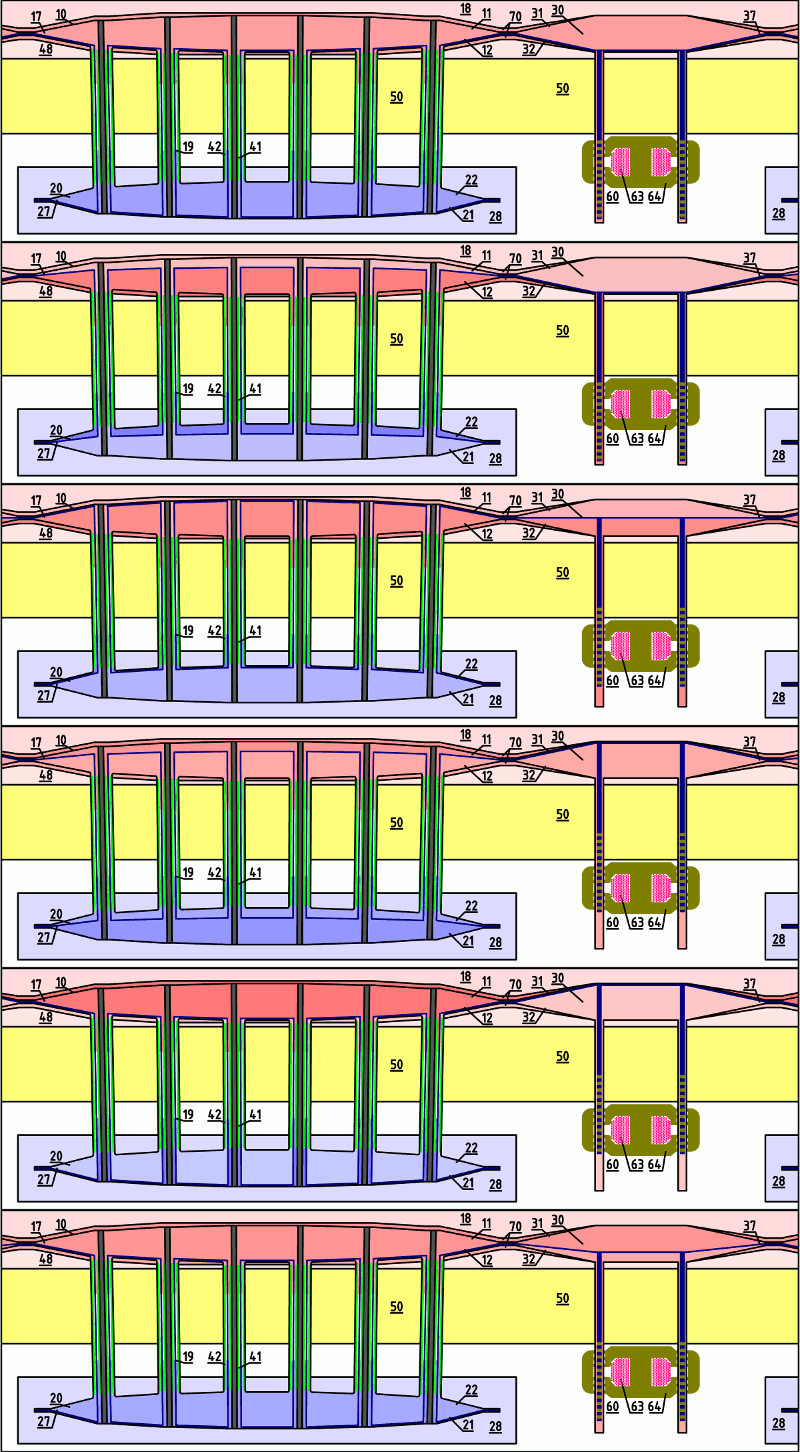
"Alpha-type Stirling engine. There are two cylinders. The expansion cylinder (red) is maintained at a high temperature while the compression cylinder (blue) is cooled. The passage between the two cylinders contains the regenerator" (Wikipedia,Stirling engine)


"Beta-type Stirling engine, with only one cylinder, hot at one end and cold at the other. A loose-fitting displacer shunts the air between the hot and cold ends of the cylinder. A power piston at the open end of the cylinder drives the flywheel. (Wikipedia/Stirling engine)


"Cutaway of the flat Stirling engine: 10: Hot cylinder. 11: A volume of hot cylinder. 12: B volume of hot cylinder. 17: Warm piston diaphragm. 18: Heating medium. 19: Piston rod. 20: Cold cylinder. 21: A Volume of cold cylinder. 22: B Volume of cold cylinder. 27: Cold piston diaphragm. 28: Coolant medium. 30: Working cylinder. 31: A volume of working cylinder. 32: B volume of working cylinder. 37: Working piston diaphragm. 41: Regenerator mass of A volume. 42: Regenerator mass of B volume. 48: Heat accumulator. 50: Thermal insulation. 60: Generator. 63: Magnetic circuit. 64: Electrical winding. 70: Channel connecting warm and working cylinders." (Wikipedia/Stirling engine)


When electric flow faces a resistor it will pack energy at the front of it. That energy packing and energy level continues rising until the energy can travel through that resistor. That thing is possible by using natural radio fields. But that requires a situation where the energy level rises high enough. Or the system uses components that are using very low energy. The superconducting systems can make this system possible. 

The idea is that radio waves are transmitted between two layers. Those layers will collect that wave movement between them. Then the system puts the antenna in those standing waves and pulls them to an electric circuit. 

The Stirling engine uses gas flow to make energy. Modern submarines use Stirling engines. But the reason why that engine type is not so popular or why piston engines replaced that engine is keeping the other side of the engine cooler is difficult without good coolers. 


The thing that moves in the tube determines if the engine is the Stirling or Coulomb engine. 


And then the other side is loaded with anions. The electrons should travel from anions to ions and the antenna in the middle of the tube can use that electron flow as an energy source. A Stirling engine is a system or tube where another side's temperature is at a lower level than the other. 

And that thing causes gas flow to the cooler side. The difference between energy levels between the sides of the Coulomb and Stirling engines determines how fast energy flows. And that determines the power of those systems.  


https://www.newscientist.com/article/2394278-quantum-engine-could-power-devices-with-an-ultracold-atom-cloud/

https://en.wikipedia.org/wiki/Air-independent_propulsion

https://en.wikipedia.org/wiki/Stirling_engine


Wednesday, September 13, 2023

Researchers can use magnetic monopoles as fundamental ion technology and ultimate stealth solutions.


Researchers can use magnetic monopoles as fundamental ion technology and ultimate stealth solutions. 


Magnetic monopoles could offer the fuel for futuristic ion engines. 


Magnetic monopoles are very short-living. When a magnetic field that pushes electrons or protons together will be turned off the magnetic forces separate those protons or electrons. The idea to use magnetic monopoles as the tool for giving thrust for the ion engines comes from that thing. The idea is that the system packs a magnetic monopole like a proton ball. 

And then the system drives that monopole in the rocket's reaction chamber. Then the electromagnetic repel pushes those particles out of the form, and those protons or electrons give thrust to the rocket. In that case, the explosion of a nuclear pellet or fusion material is replaced by using a magnetic monopole. The power of those systems might not be as high as a fusion engine, but those magnetic monopoles that split into pieces will give thrust to spacecraft or aircraft. 

In some visions, the ball-shaped lighter-than-air vehicle will use the magnetic monopolar shell to transfer ions behind it. The idea is that the system sprays ions to the front of the craft. And then those ions impact with other ions that come from the back. That thing causes the plasma pulse that can push the craft forward. 

It's possible that in graphene net are protons or electrons. The electron layer could be anchored over that proton layer. And then those electrons form the magnetic monopole around that craft. 

There is a possibility that some so-called UFOs are ball-shaped aerial vehicles that use plasma or pulsed plasma engines. The system would be the mylar-ball-airship, where is the whisk-looking structure inside it. The whisk-looking structure is the thing that transfers ions in the wanted direction. That happens by conducting electricity into the wanted wheel of that whisk. The system works like a giant Earth when it creates the plasma pulse. The plasma travels through the N and S-poles and then those anion and ion flows will impact behind that ball forming the thrust. 


The plasma pulses can also make aircraft invisible to radars. Also, plasma pulses can be used as plasmoid weapons. In those systems, the ion or anion cloud will shoot ahead incoming target. 


The high-energy particles cause problems with satellites. And that makes plasmoid or plasma-ion weapons dangerous. If an attacker loads an object, like a satellite using N-pole electricity. That makes it pull electrons or high-energy killer electrons into its shell. 

Those killer electrons are quite the usual thing in Van Allen belts. When electrons travel around the Earth they will get energy from the Sun and cosmic radiation as well as from plasma that Earth is trapped in those Van Allen plasma belts. 


"A new study reveals the escalating threat of “killer electrons” during geomagnetic storms, urging for fortified satellite infrastructure to mitigate potential space weather damages. This research serves as a benchmark for preparing and safeguarding the expanding space sector, which significantly influences a myriad of industries and global communications." (ScitechDaily.com/Space’s Silent Threat: Scientists Shed New Light on “Killer Electrons”)


Iron, stealth, and magnetic monopoles are an interesting combination. 


Then, that target will loaded with a magnetic field with opposite polarity. If the target travels through particle clouds with N-polarity, and the target itself has S-polarity. That causes a situation where those N-polarity particles are impacting the craft. That particle flow can destroy the target if the impacting particles have a very high energy level. And that thing makes so-called killer electrons devastating. 

ELF radiowaves are pushing those high-energy electrons away from the satellite. But the same thing pulls killer protons, or extremely high energy protons to the satellite. The negative electromagnetic fields can pull anti-electrons or positrons against targets. And that makes protection against those high-energy particles very hard. 

There is the possibility to turn things like iron atoms in one direction by using extremely powerful magnetic fields. That thing means that if in the middle of an aircraft or spacecraft is a high-power magnet that thing can turn N- or S-poles in the same direction. And that thing makes it possible to cover the entire layer with only N- (or S) poles. That thing forms the magnetic monopole layer that aims ions and radio waves in one direction. And that kind of monopolar layer makes the new types of stealth possible.

Even if the magnets cannot turn atoms in iron crystals in one direction, their 2D graphene can make this thing possible. In that model, the system will put iron atoms into the holes in 2D graphene. And then magnets will turn that thing in one direction. That allows the system to create a layer, where there is only an S- or N pole. The monopolar magnetic layer can make ultimate stealth possible. 

https://miraclesofthequantumworld.blogspot.com/2023/09/researchers-at-aalto-university-created.html

https://scitechdaily.com/spaces-silent-threat-scientists-shed-new-light-on-killer-electrons/


Friday, March 11, 2022

Researchers uncover the reason for cosmic bubbles near the Milky Way.


Image 1) The cosmic bubbles at both sides of the Milky Way


The reason for cosmic bubbles near Milky Way galaxy is in the radiation of the Sagittarius A the supermassive black hole in the center of our galaxy. When that radiation impacts the gas atoms above and below the Milky Way galaxy that thing causes the emission radiation. The effect is similar to the thing that happens in neutron bombs. 

The radiation effect will push the quantum fields of neutrons inside and load them with energy. When that energy transfer ends neutrons are sending radiation whose wavelength is the same as the diameter of the neutron. 

When radiation hits atoms or their quantum fields they are sending wave movement. Which is similar to neutron radiation. When that reflection radiation hits other atoms. That radiation pushes them away from each other. And this thing forms the cosmic bubble, where are fewer atoms than in other places universe.


https://www.sciencealert.com/giant-bubbles-expanding-from-the-milky-way-could-be-explained-by-a-single-event


Image) https://www.sciencealert.com/giant-bubbles-expanding-from-the-milky-way-could-be-explained-by-a-single-event


Image: Pinterest


What makes this thing interesting. 


If we think the ability to make the electromagnetic field in the air that pushes atoms away from each other we could make the "Jedi effect". The lower pressure that can be made to the wanted direction from the object can be used to move the object. 

Making that kind of low-pressure bubble requires radio- or other electromagnetic radiation. The bubble can create by pointing electromagnetic radiation to the air molecules. And the reflection will push those molecules away from each other. 

If the exhaust gas of the jet engine is driven through the vacuum bubble the speed of exhaust gas increases. And that thing makes it possible to increase the aircraft's speed without using an afterburner.  

The electromagnetic bubble can also use to increase the thrust of jet engines. The idea is that the electromagnetic bubble is made just after the nozzle of the jet or plasma jet engine. And the engine will drive exhaust gas through that vacuum. 

The vacuum behind the jet engine increases the speed of exhaust gas. Because the exhaust gas must travel through a vacuum before they impact with air. That thing can make more speed to the exhaust gas without an afterburner. The vacuum bubble behind the jet engine can form by using microwave or laser systems. And the similar bubble can work with electric- and regular jet engines. 

The thing that makes the electric jet or pulsed plasma turbine (PPT) very suitable for jet fighters is that another aircraft cannot fly behind that engine. The ionized gas protects at least partially the aircraft. Against the missiles that are shot from the back. 


https://thoughtandmachines.blogspot.com/

Sunday, December 3, 2017

Radical aircraft design whatever be more than drawing on the paper.

Artist impression of ""Focke Wulff" "Triebfluger"
(Source: Internet)

Kimmo Huosionma

Focke Wulf  "Triebfluger" was an airplane, what was only existed in the paper. The ”Triebfluger” have been very radical design for the VTOL (Vertical Take-Off and Landing) aircraft, what could change our visions if the aerodynamics. The "Trieblfluger" was inspired one of the greatest ways to operate with the helicopters. Those helicopters could be easier to manufacture, but they will need the jet motors on the edge of the wings of the propeller.

In this ”simpler way” to make flying machines is one thing forgotten, those jet motors will be very complicated to build, and they will suck the kerosine with very fast speed, and that is the reason, why this kind of helicopters would ever build. In this scenario, the helicopters rotor is equipped with jet motors, and the fuel will come from the rotating ventilation in the middle of the rotor.


The reason why that way to build helicopter is very uncommon, is that helicopter will wear very much gasoline, but the inventors of the Focke-Wulff corporation calculated, that design will be easier to produce than normal jet turbine helicopter, what needs very complicated gearwheels, because the speed of the rotor must be decreased in the limits, that this system's structure will stand those G-powers.


This helicopter type what is represented the "Triebfluger" is called as the ”free rotating” helicopters, what are sometimes been on the table of designers. That helicopter is simpler to manufacture, but the motor system is very complicated because the use of the jet motors for rotating the wings. The ventilation system would be very easy to put in the rod of the main rotor, and it is very easy to impose. Or the bond must only be rotating. Another ventilation system might be fixed.

New autonomous task units are entering service.

"The deal will create much-needed competition for the Department of War acquisition process. (Representational image)" (Interestin...