Wednesday, March 6, 2024

Quantum breakthrough: stable quantum entanglement at room temperature.


"Researchers have achieved quantum coherence at room temperature by embedding a light-absorbing chromophore within a metal-organic framework. This breakthrough, facilitating the maintenance of a quantum system’s state without external interference, marks a significant advancement for quantum computing and sensing technologies". (ScitechDaily, Quantum Computing Breakthrough: Stable Qubits at Room Temperature)

Japanese researchers created stable quantum entanglement at room temperature. The system used a light-absorbing chromophore along with a metal-organic framework. This thing is a great breakthrough in quantum technology. The room-temperature quantum computers are the new things, that make the next revolution in quantum computing. This technology may come to markets sooner than we even think. The quantum computer is the tool, that requires advanced operating- and support systems. 

When the support system sees that the quantum entanglement starts to reach energy stability. It must start to create another quantum entanglement and transport data out from the first entanglement. Another way to make the quantum entanglement stable. Is to pump energy out from the receiving part. 

Information is like the plague on the qubit. And quantum entanglement is like a wire that transports that plague to another qubit. So, qubits are particles in both ends of quantum entanglement. The system makes superposition and entanglement between those particles. 

In that process, the system adjusts those particle's oscillations into the same frequency, and if another particle's energy level is lower, that makes the energy and information flow to the lower energy particle. Stable quantum entanglement is required. That the system can keep receiving part of the quantum entanglement at a lower energy level. 

. 
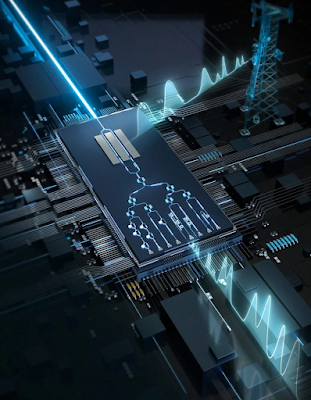


"The team has developed a world-leading MWP (Microwave Photonics) chip capable of performing ultrafast analog electronic signal processing and computation using optics. Credit: City University of Hong Kong" (ScitechDaily, 1,000x Faster: Ultrafast Photonics Chip Reshapes Signal Processing)

When both sides of the qubit are at the same level, a standing wave between them breaks quantum entanglement. The support system can send a side-coming laser beam to the receiving qubit. That makes it transport energy into the lower energy particles. Then the system must create a qubit to the opposite side. Those qubits can form a morphing network in the system

The AI-controlled systems require microchips that can operate at very high speed. The photonic microchips are 1000X faster than regular microchips. The photonic microchips do not form magnetic fields around them. And that system can operate with quantum computers. The AI-based operating systems control photonic microchips whose mission is to turn binary data into qubits. And that thing makes photonic microchips more powerful than ever before. 


AI-based kernels and operating systems increase those systems' power. 


In the structure, the photonic microchips can also act as morphing tools. It's possible. That the morphing microprocessor can change its state between quantum computers. And binary computer. That makes this kind of system flexible and powerful. The new metamaterials make it possible to create switches and logical gates that make this system more effective. 

When researchers want to make extremely fast binary microprocessors. They can use three lines. Two lines transport data. The operating system system interprets data that travels in line 1 as zero (0). Data that travels in line 2 is interpreted as one (1). There is also the third line, that tells that the power is on in the system. This kind of system can have three layers. 


1) Regular binary layer that runs AI-based operating system. 

2) Photonic processor layer. 

3) Quantum layer.


The regular binary layer controls the AI-based kernel. The photonic microchips can be even faster than nobody believed. The system may give numbers for every data impulse that it sends through photonic microchips. In that system, the bit has a recognition part, but that requires the AI-based operating system and AI-based kernel. 

In that system, the transmitter sends number 1 (or 3,5,7...). That tells the operating system that the data bit comes from line one. And when the system sends 2 (or 4,6,8..) That thing is interpreted as line 2. The regular binary system is the thing that controls the photonic system. 

That helps the AI-based operating system connect those bits in the right order if there is a malfunction in those lasers. The wire 1 can give odd numbers to the bit. And line can give an even number for the bit. That ability to number those bits makes it possible to transport data in one line. 


https://scitechdaily.com/1000x-faster-ultrafast-photonics-chip-reshapes-signal-processing/


https://scitechdaily.com/metamaterial-magic-scientists-develop-new-material-that-can-dynamically-tune-its-shape-and-mechanical-properties-in-real-time/


https://scitechdaily.com/quantum-computing-breakthrough-stable-qubits-at-room-temperature/


Why AI should forget things?


Memory is like an attic. If there is lots of stuff that makes it slow and if the attic is full of stuff, that means the owner must check much more merchandise than in a clean attic. When people are cleaning their attics and carrying unnecessary merchandise away. 

That makes it easier to use that room. People forget things because that makes their memory effective. If there are left only things. that people need that makes the memory effective.  And one reason for removing things from memory is that we don't use them. In this text system, the brain and computers follow the same rule. They forget because their memory is not unlimited. 


Image:Quanta Magazine

Why do we forget? Forgetting things makes our memory more effective because there are not so many memories. Memory is an impressive thing, but even human memory is not unlimited. When the system stores something in memory, it must reserve one memory unit for each memory. And when the system wants to find something in memory, that requires that it must check every memory unit. The memories of computers and the human brain operate the same way. They store memories in a network structure. That memory does not have unlimited capacity. 

So, if we don't use some memories, we should not store them. If the system erases memories that it doesn't use, that releases those memory units for new memories. Memory is like a network of cells that form a network and reconnect those cells in a morphing neural network makes possible to reshape images and memory entireties. 

When artificial intelligence erases some memories, it does the same thing that regular computer users do every spring. It cleans its memory from unnecessary data, which makes it faster. The algorithm determines how often a user or program must open a certain file. If the file is not open, or it has no other connections with used software, that means the system erases that file. That kind of thing makes the AI more effective. 

https://www.quantamagazine.org/how-selective-forgetting-can-help-ai-learn-better-20240228/

Fusion startup plans to clean orbital trajectories using laser rays.


The idea of lasers use as satellite killers is not new. The problem is how to create high-power lasers that can operate at the orbital trajectory. Another problem is how to remove debris from the orbiter. The satellite killers are based on the new ideas to remove space junk from orbiters. 

The same systems that are used to remove space junk can be used in wartime to push enemy satellites to the ocean. The other version is to use EMP impulses to shut down enemy satellites. This system is required for removing EMP or FOBS (Fractional Orbital Bombardment System) weapons from the orbiter. Also, it can destroy low-flying recon satellites pushing them into the atmosphere. There is suspicion that FOBS is a so-called sleeping satellite, equipped with a nuclear warhead. 


In some other models, satellites can use tiny soft ammunition that can push the targeted satellites to the atmosphere without destroying them. In some other versions robot connects small balloons to satellites, and then the laser detonates those balloons to push the satellite out from its trajectory. There could be some marking system in a satellite. That tells if there is a malfunction. And it must removed from space. 


There are plans for the Flying recycle bin or junk collect spacecraft can take those non-operational satellites out of the orbiter. The spacecraft just pulls the targeted satellite in it. And then it returns to the ground. This helps to keep classified military satellites secretive. And the crew can analyze if there are attempts to affect that satellite. 


In the future, there can be service robots at orbiters whose mission is to connect small rockets to satellites that are not operational anymore. Then those small rockets can push satellites to the Pacific Ocean. 

In some visions, the satellite operators must leave a small fuel dose to the satellite, so that they can push them into the atmosphere. Another vision is that satellites can be equipped with heat shields and satellites, and they would return to the ground using parachutes. That allows us to use those systems to analyze the cosmic radiation effect on microchips. And then a normal recycling center can recycle those satellites. 

The idea of this kind of thing is not to destroy satellites. Or this kind of lasers will not put them into pieces. The idea is that a laser system can push a satellite or another space junk into the atmosphere. The high-accurate laser ray can hit a hole in the satellite's fuel tank. 

And leaking fuel pushes satellites into the atmosphere. The laser that makes this operation can be ground-based. The mirror that is above the orbital trajectory can aim the ground-based laser at the target, and then reflect laser ray into the targeted satellite. 


https://www.freethink.com/space/space-junk-fusion


https://thehill.com/opinion/national-security/578797-the-return-of-fobs-china-moves-the-space-arms-race-into-the-nuclear


https://en.wikipedia.org/wiki/Fractional_Orbital_Bombardment_System

Tuesday, March 5, 2024

Photonic Microchips and AI-based operating systems make the most powerful systems in the world.

"DataCebo, an MIT spinoff, leverages generative AI to produce synthetic data, aiding organizations in software testing, patient care improvement, and flight rerouting. Its Synthetic Data Vault, used by thousands, demonstrates the growing significance of synthetic data in ensuring privacy and enhancing data-driven decisions. Credit: SciTechDaily.com" (ScitechDaily, Generative AI: Unlocking the Power of Synthetic Data To Improve Software Testing) 

In software testing, the AI can connect itself with simulators or record data from environments or similar systems. Then the interactive AI can interact with those systems and models. Similar systems can used for physical tools. 

"DataCebo offers a generative software system called the Synthetic Data Vault to help organizations create synthetic data to do things like test software applications and train machine learning models. Credit: Courtesy of DataCebo. Edited by MIT News."  (ScitechDaily, Generative AI: Unlocking the Power of Synthetic Data To Improve Software Testing) 


The new microchips can revolutionize the quantum computer development. Those photonic microchips are systems that can keep a computer's temperature low. It's possible. Photonic microchips can also change their states between binary and quantum modes. Those new microchips require highly advanced operating systems that can control them accurately. 

The microchip itself does nothing. Operating systems and software are also important tools for successful computing.  In AI-based systems, the center of the system is the language model. That model can search for things on the Internet. 

Or it can use limited datasets. The AI-based operating system can activate needed applications. Or if that application is not installed or the system has no access to it. That AI-based system can search that application from the application store. Then the system can ask, will the user wants to use a keyboard or spoken words. Starting to drive commands to that application. The application might involve a database. That tells the AI what kind of commands the application requires. And then the AI can use those commands to control the application. 


"Researchers have developed a groundbreaking light-based processor that enhances the efficiency and scalability of quantum computing and communication. By minimizing light losses, the processor promises significant advancements in secure data transmission and sensing applications. Credit: SciTechDaily.com" (ScitechDaily, Quantum Computing Takes a Giant Leap With Light-Based Processors)


Generative AI can use synthetic datasets to improve research. 


The morphing network. Along with generative AI, morphing networks can collect data from multiple data sources. That means it can collect data from multiple laboratories. And the networked AI can use simulations with highly accurate computing to make simulations of the materials and their behavior in certain environments. When we think about synthetic data, we can use multiple sources to get that data. And we can connect arbitrary numeric and chemical values in that data. This type of dataset can simulate thermal effects in microchips very accurately. 

The new and powerful AI requires an AI-based operating system. That can control microchips and other hardware interaction with software very accurately. That allows the system to shut down part of the microprocessor's cores if its temperature rises too high. 

Image: FreeThink.com


The over-human software developers that are AI-controlled development environments that are the most effective systems in the world can use this type of synthetic data for the R&D process. 

In the case of physical systems like cars or ships, this kind of tool can collect data from different accidents. And things that cause most inspection rejections. Then the system can collect data from other vehicles where those points don't cause denies, and then that system can connect those solutions with new models. In the same way, the AI-based software development tool can search for things like data security- and other vulnerabilities following parameters that are stored in the system. 

The AI-controlled developer can connect with the AI-based operating systems. That can adjust the microchip operations. That thing makes those systems even more effective. However, the AI-based software development system requires an operating system that interacts between software and hardware. 

https://www.freethink.com/robots-ai/ai-software-engineer


https://scitechdaily.com/generative-ai-unlocking-the-power-of-synthetic-data-to-improve-software-testing/


https://scitechdaily.com/quantum-computing-takes-a-giant-leap-with-light-based-processors/

AI and fusion.


Artist's rendition of a nuclear fusion reactor. (Intersting Engineering, New superconducting magnets ready for fusion reactions, say scientists)


AI has a great ability to control entireties. The new AI-controlled fusion systems can precisely control the energy levels in the systems.  The ignition point is one of the biggest problems in fusion systems. If the energy level in high-speed plasma is too high, that thing causes a shockwave that destroys the entirety. Plasma spreads to large areas that the magnetic fields can control. When ignition happens the system must press plasma together, or shockwave and energy entropy destroy the plasma ring. 

The precise point of the plasma ring where ignition happens is one of the most important things. If fusion starts inside the plasma ring, that thing causes an outgoing shockwave. And that shockwave destroys the plasma. If the ignition area covers the entire plasma ring, and it happens at its shell the ignition forms a shockwave that travels into the plasma and presses it forming large-area fusion. 

That's why ignition must happen in the entire plasma ring if we talk about torus or tokamak reactors. In some visions, the plasma ring will start in high-temperature conditions. 

Then the system sprays opposite pole particles into the tokamak reactor. And then those particles should impact the plasma ring. If those impacts cover the entire plasma ring, that should cause a pressure wave that will create fusion into the entire plasma ring. 


"A a view from inside the OMEGA target chamber during a direct-drive inertial fusion experiment at the University of Rochester’s Laboratory for Laser Energetics. Scientists fired 28 kilojoules of laser energy at small capsules filled with deuterium and tritium fuel, causing the capsules to implode and produce a plasma hot enough to initiate fusion reactions between the fuel nuclei".(ScitechDaily, Scientists Demonstrate Effective Fusion “Spark Plug” in Groundbreaking Experiments)

 The temperatures achieved at the heart of these implosions are as high as 100 million degrees Celsius (180 million degrees Fahrenheit). The speed at which the implosion takes place is typically between 500 and 600 kilometers per second (1.1 to 1.35 million miles per hour). The pressures at the core are up to 80 billion times greater than atmospheric pressure. Credit: University of Rochester Laboratory for Laser Energetics photo / Eugene Kowaluk" (ScitechDaily, Scientists Demonstrate Effective Fusion “Spark Plug” in Groundbreaking Experiments)


"Focused ion beam technology is pivotal in nanoscale materials processing, with a new EU report outlining its broad applications and potential for future breakthroughs in science and technology. Credit: SciTechDaily.com" (ScitechDaily, Ion Beams Unleashed: The Nanotechnology Game Changer)


The pulse-plasma fusion or "the candle model". 


Basically, crossing ion and anion beams can begin a fusion reaction. In those systems ions and anions are impacting. And that forms fusion that can release very high power energy impact. 

In the candle model, the anions and ions impact along with the laser beams that ignite fusion. One of those systems is two crossing linear accelerators where ions and anions impact. The linear accelerator can shoot those particles together. And in the same moment, the system shoots laser rays at the impact point. That is a simpler system than tokamak, and the fusion is easier to create. But there is always a problem with how to make fusion systems create more energy than used. 

The other version is called the candle model. In that model, the fusion system pushes ionized gas from the tube to the fusion chamber. Then the system injects opposite pole plasma into the ignition chamber. The system looks like NIF (National Ignition Facility). 

Except there is an ion pumping system around the protective building. The ion accelerators increase those ions speed and then they will impact with the anions that come from the tube. Along with high-power laser systems that system should create oscillating ion-anion fusion that could give more energy than it uses. 


https://www.freethink.com/energy/nuclear-fusion-reactions


https://interestingengineering.com/energy/new-superconducting-magnets-ready-for-fusion-reactions-say-scientists


https://lasers.llnl.gov/about/what-is-nif


https://scitechdaily.com/ion-beams-unleashed-the-nanotechnology-game-changer/


https://scitechdaily.com/scientists-demonstrate-effective-fusion-spark-plug-in-groundbreaking-experiments/

Monday, March 4, 2024

Graphene as an insulator. And nano-size hovercraft.


"Schematic representation showing how a graphene layer protects against water. The electrical current flowing along the edge of the topological insulator indenene remains completely unaffected by external influences. Credit: Jörg Bandmann, pixelwg" (ScitechDaily,Quantum Leap in Ultrafast Electronics Secured by Graphene’s Atomic Armor) If electricity transports water in one direction. The system can use the same effect to transport miniature robots on water. 


"Amalgamation of experimental images. At the top, a scanning tunneling microscopy image displays the graphene’s honeycomb lattice (the protective layer). In the center, electron microscopy shows a top view of the material indenene as a triangular lattice. Below it is a side view of the silicon carbide substrate. It can be seen that both the indenene and the graphene consist of a single atomic layer. Credit: Jonas Erhardt/Christoph Mäder)" (ScitechDaily,Quantum Leap in Ultrafast Electronics Secured by Graphene’s Atomic Armor) 


New electric systems require an extremely good insulator. Nanotechnology means that old-fashioned insulators are useless. A graphene membrane can protect components against water. The electric flow in the graphene makes it a good insulator that denies the inner side of the topological insulator getting outside effects. That kind of thing makes graphene one of the most interesting materials. The same thing that can make graphene repel water can be used in new nanotechnical solutions.

One of them is the nano-size robot that can hover above water. The system can make an electric load on graphene, and the system can hover above the layer using some nano-acoustic systems. That thing can make the small graphene hovercraft rise above the water layer. 


In a graphene structure, the fullerene balls are like small wheels that transport the miniature machine forward. There is the possibility that nano-diamonds send acoustic waves that make this system hover and move at least in liquids. In nanotechnology, small sizes of machines make them more effective and behave in other ways than their "big versions". 

In some models, graphene can trap water molecules. When the system turns the minus or plus poles in a certain way. It can be used to aim ion beams into the right position. The system can put behind the object, and then the ion cannon shoots ions. In that case, the opposite electric pole pulls ions into it. And that increases the ion system's accuracy. 

Graphene can also be used to trap water in it. The ability to change the direction of the water molecule makes it possible to create ultimate stealth materials. If the system can turn the molecule's positive or negative side outside, that thing makes this thing possible to create a layer that can pull electricity or radiowaves in it. 


https://scitechdaily.com/quantum-leap-in-ultrafast-electronics-secured-by-graphenes-atomic-armor/


https://learningmachines9.wordpress.com/2024/03/05/graphene-as-an-insulator-and-nano-size-hovercraft/


Ion beams are next-generation tools for nanotechnology, military, and medical use.


"Focused ion beam technology is pivotal in nanoscale materials processing, with a new EU report outlining its broad applications and potential for future breakthroughs in science and technology. Credit: SciTechDaily.com" (ScitechDaily, Ion Beams Unleashed: The Nanotechnology Game Changer)


Ion engines use ions as thrusters. The ion accelerator pushes ions back into the magnetic track. Then those ions will transport craft forward.  

Ion beams are particle flows that are formed by electrically loaded particles. The systems can use ion beams to transport material over distances. The system can ionize things like raw materials and send them to the receiver. That must only remove electricity from ions and turn them into neutral atoms. 

The ion beams can also destroy cancer cells and disinfect surfaces. In some visions. Sometimes in the future, the ion systems can used to create giant 3D structures. And that makes it possible to create space stations using ions and anions that are stored in tanks. But today we are far away from that thing. 

In nanotechnology, ion systems can play billiards with ionized atoms. And that thing makes it possible to create 3D structures. The accurate ion systems make it possible for the system. That can adjust the energy that focuses on the structure. The highly accurately adjusted energy allows those systems can shoot ions into the structure without breaking it, and that makes it possible to use them as highly advanced 3D printers. That can make very accurate atom structures. 


Acoustic or electromagnetic wormholes can allow the system to shoot ions in long range. The system can use a combination of acoustic wormholes and laser beams that make the ion channel through the air. If the wormhole or eruption channel is empty enough. 

That can be used to shoot antimatter particles to the target. In those cases, the antimatter particles must not touch the material. The photon or laser accelerators can pull energy to the ions and anions when they fly through the wormhole. 

Ion beams can used in highly advanced military systems. If in the negative ion beam are also protons or positive ions that help to keep the beam in the formation. The ion cannon can shoot ions in long distances if it shoots that particle flow through acoustic wormholes. 

The acoustic- or pressure wormholes are the channels in the air. The system can make them using some kind of acoustic system or the systems that shoot laser rays through the air. Lasers or some other electromagnetic radiation can used to make a plasma channel that allows the ion system to shoot ions in the long range. 


https://scitechdaily.com/ion-beams-unleashed-the-nanotechnology-game-changer/


The AI makes advancements in the atomic force microscopy.

"Researchers at the University of Illinois Urbana-Champaign have introduced an AI technique that significantly improves Atomic Force Microscopy (AFM) by enabling it to visualize material features smaller than the probe’s tip. This breakthrough, offering the first true three-dimensional profiles beyond conventional resolution limits, promises to revolutionize nanoelectronics development and material studies". (ScitechDaily, New AI Breaks Fundamental Limitations of Atomic Force Microscopy)


"Atomic force microscopy (AFM) or scanning force microscopy (SFM) is a very-high-resolution type of scanning probe microscopy (SPM), with demonstrated resolution on the order of fractions of a nanometer, more than 1000 times better than the optical diffraction limit." (Wikipedia, Atomic force microscopy)


The atomic force microscopy is one of the sharpest known systems in the world. 


The AFM  (Atomic Force Microscopy) is not the same as a scanning tunneling microscope. But connecting those two microscopes. It's possible to create more fundamental microscopes than ever before. If a scanning tunneling microscope can hover a single photon between the stylus and layer, that thing will be more powerful than previous systems. The ability to stop single photons makes this kind of system possible. 

Scanning tunneling microscope bases the stylus. And the particle hovers between the layer and that stylus. Scanning tunneling microscope sees objects that are smaller than atoms if electrons hover between layer and stylus. The scanning tunneling microscope's accuracy depends on the hovering particle's size. 


"An AFM generates images by scanning a small cantilever over the surface of a sample. The sharp tip on the end of the cantilever contacts the surface, bending the cantilever and changing the amount of laser light reflected into the photodiode. The height of the cantilever is then adjusted to restore the response signal, resulting in the measured cantilever height tracing the surface." (Wikipedia, Atomic force microscopy)


The scanning tunneling microscope sees atoms, but there is one bad thing. The large-scale scale structure scan takes time. If the scanner uses a tool, that is smaller than atoms almost every structure is large. The thing in AI is that it can control large entireties very accurately. So the system can use a large group of scanning tunneling microscopes. The large group of stylus and hovering particles makes it possible to create a net eye. That can scan larger areas. 

This ability is necessary in nanotechnology. When a system creates complicated structures, it must see what it does. The new types of AI-based solutions are the tools that revolutionize nanotechnology. In nanotechnology, the AI controls a large number of observation and control tools at the same time. 


"An artist’s rendering of nitrogen vacancy centers in a diamond anvil cell, which can detect the expulsion of magnetic fields by a high-pressure superconductor. Credit: Ella Marushchenko" (ScitechDaily, Quantum Leap in Superconductivity: Harvard’s High-Pressure Breakthrough)


Harvard's new high-pressure superconducting is more fundamental than we might believe. 


In new superconducting systems, the diamonds give an acoustic effect. The system can use photo-acoustic mode, where laser light transports energy into those diamonds. Diamonds are homogenous structures that can create identical acoustic waves. Those acoustic waves can put very high pressure on the object. And that system can turn material superconducting at a higher temperature than usual. 

In superconducting technology, pressure can compensate for low temperatures. And that makes it possible to create superconductivity in higher temperatures. The system can adjust superconductivity using soundwaves and can hover some objects between diamonds. Then that object can act as an antenna that conducts em-radiation into the wanted position. 

The AI can also make new types of superconducting solutions possible. The pressure-based superconducting makes it possible to control the superconducting state. When the pressure system is on, the system presses the object into the superconducting shape. When the system doesn't require a superconducting part. It can turn off the pressure system. That system can make fundamental things in microchips and nanotechnology. Of course, superconducting systems can make solid-state, compact quantum computers suitable.

One point there this kind of system can use is in next-generation radar technology. Small-size superconducting antenna can give new abilities for radars. When the acoustic system is off, the radar operates in normal mode. Then acoustic system turns the radar into superconducting mode. 


https://scitechdaily.com/new-ai-breaks-fundamental-limitations-of-atomic-force-microscopy/


https://scitechdaily.com/quantum-leap-in-superconductivity-harvards-high-pressure-breakthrough/


https://en.wikipedia.org/wiki/Atomic_force_microscopy


https://en.wikipedia.org/wiki/Scanning_probe_microscopy

Saturday, March 2, 2024

The new prosthesis gives man feeling.


Technology advances. And modern prostheses might have the ability to feel things. This kind of prosthesis is a new tool for medical operations, and it can interact with the human nervous system using intelligent electrodes that deliver and receive nervous signals. 

This kind of system can used with intelligent neural wristbands. Those wristbands can connect the user's nervous system to the prosthesis. 

The same technology created for prostheses can used in hand-shaped manipulators. That prosthesis can also connected with a robot, that communicates with users over the internet. 

They can also used with remote-control human-shaped robots. In those systems, the controller can control robots using the BCI  (Brain-computer interface) or in more practical models the user can use the VR (Virtual Reality) Glasses, data gloves, and intelligent wristbands, that send neuro-impulses to the robot. 

That new prosthesis can increase the ability to make people's lives better after the amputation. These kinds of tools are turning human-robot hybridization closer. And that also improves the ability to use things. Like space suits and other protective systems. Technology created for that prosthesis can used to give the feel of touch to space suits. 


By the way...


In K.W Jeter's SciFi book Dr. Adder, the author predicted the weaponized prosthesis. The prosthesis uses a nuclear battery and it interacts with the human nervous system. The computerized prosthesis had IR cameras, that send the images to hand nerves. It used acoustic or laser systems whose mission was to destroy objects. Using modern nanotechnology is possible to create flat loudspeakers that can create sound that destroys red blood cells. 

This kind of system is possible to make quite soon. In some scenarios, surgeons can put that prosthesis on an amputated hand. And the surgeons who make that operation would put the hand into the cryogenics. 

When the mission is over the surgeon removes the prosthesis and reconnects the natural arm with the operator. The idea is stolen from the KGB execution machine, the high-voltage glove there are electrodes where there is high-voltage electricity. If that system touches a person, that causes deadly electric shocks. 


https://www.freethink.com/health/man-feels-hot-and-cold-again-with-prosthetic-hand-breakthrough


The new tiny accelerators can make a revolution in many technologies.


"Illustration of a shoebox-sized accelerator. An electron source and buncher/injector feeds into a sub-relativistic DLA (the device described in this article), which accelerates electrons up to 1MeV in energy. These electrons are further accelerated by SiO2 waveguide-driven relativistic DLA, and finally pass through an undulator to produce coherent free-electron radiation. Credit: Moore Foundation / Payton Broaddus" (ScitechDaily, Stanford’s Tiny Accelerator Promises Giant Leaps for Medical and Physics Breakthroughs)


New tiny particle accelerators are one of the most interesting things in the world. This system makes it possible to create new materials. And one of the purposes of this kind of particle accelerator is to shoot ions into diamond structures. This system can shoot other atoms in ion form in carbon structure because ions can push carbon atoms away from their route in diamonds. That makes it possible to make diamond-based quantum computers. 

Tiny particle accelerators can also used in material research. But those systems are also suitable for plasma stealth systems. The aircraft or any other vehicle can surround using low-energy ion or anion plasma, and that thing can used to create the layer that pulls radio waves in it. That thing can make the plasma stealth true. 

The tiny particle accelerators can be the ion engine system. In ion engines, those particle accelerators can act as ion accelerators. In weapon solutions, the target can load using plus or minus electricity. Then the ion cannon shoots particles with opposite polarity. That thing makes the system pull particles to the target. 

In some models, the system can use tiny particle accelerators in antimatter engine systems. In those systems, the particle accelerators shoot electrons or protons into the gold layer. Along with the magnetic field that thing forms the antimatter like antiprotons or positrons. The antimatter system can involve multiple tiny particle accelerators. 

The problem with high-power lasers that shoot outside the atmosphere is that those systems require massive power sources. And the only small enough energy source for those laser systems has been a neutron bomb. The neutron bomb will detonate around the laser element or at the side of the laser, it gives light to the laser element. 

The antimatter or annihilation flashes can used in laser systems. Those annihilation flashes can be as bright as hydrogen bomb explosions. And the antimatter systems can replace nuclear weapons in X- and futuristic gamma-ray lasers. The extremely bright light flash can create a very bright laser ray. That is as powerful as nuclear weapon-boosted lasers, where fission elements surround laser elements. Those weapons were the most powerful lasers planned to use outside the atmosphere. 


https://scitechdaily.com/stanfords-tiny-accelerator-promises-giant-leaps-for-medical-and-physics-breakthroughs/

Why must students learn, how to use AI?


When we want to allow something, that thing must not be allowed in all situations. We can use AI using our private cell phones anyway. At first, we must realize one thing. The AI is not the same thing as calculators. And the second thing that we should realize is that if a student makes texts at home or free time, nothing can deny the use of AI. The third thing is that AI requires very careful articulation. And the formation of the questions must made accurately. 

Also, the person who uses the AI must have a good knowledge of the topics, or the AI writes crab. The fact is that the working life requires the skill of the use of the AI. And most of us study for working life. The problem is that if students just copy-paste articles that the AI generates, that causes a loss of writing skills. And that is not a good thing. The use of the AI is very important. And the generative AI is a powerful tool. But the problem is a misuse of that thing. The generative AI is a tool that we can use on our cell phones. 

That thing makes it possible for a person can ask AI to make the answer, and then write that text that is on the cell phone's screen. Students can make texts using computers that they bought themselves, and that causes problems with control. Laptop computers are not very expensive and big investment, and there are no limits to the use of those systems. Then the person can send that text to the School computer using email. And that is one of the biggest arguments for allowing the use of AI at schools. There is no way to control those tools. 

The use of the AI must not be allowed in every situation. When we talk about the use of some tools, sometimes some people think. This kind of tool is allowed in every situation. That means that the use of AI can be limited in examination situations. In those cases, the network can limited to only to examination workspace. And that means the teacher can turn the classroom network to examination mode. 

If we think about cheating in examination situations. There is always a possibility that the teacher makes answers for some students. The use of laptops makes it possible to make sure that a student sits on a laptop while that person makes the examination. 


https://www.freethink.com/robots-ai/chat-gpt-students-writing

Tesla’s flying roadster is an interesting concept.

Image: Tesla/Interesting engineering.  A flying car is a term for an aerial vehicle. It can fly. It can also travel on the road like a car. ...